

GATE Academy
-May 18, 2026
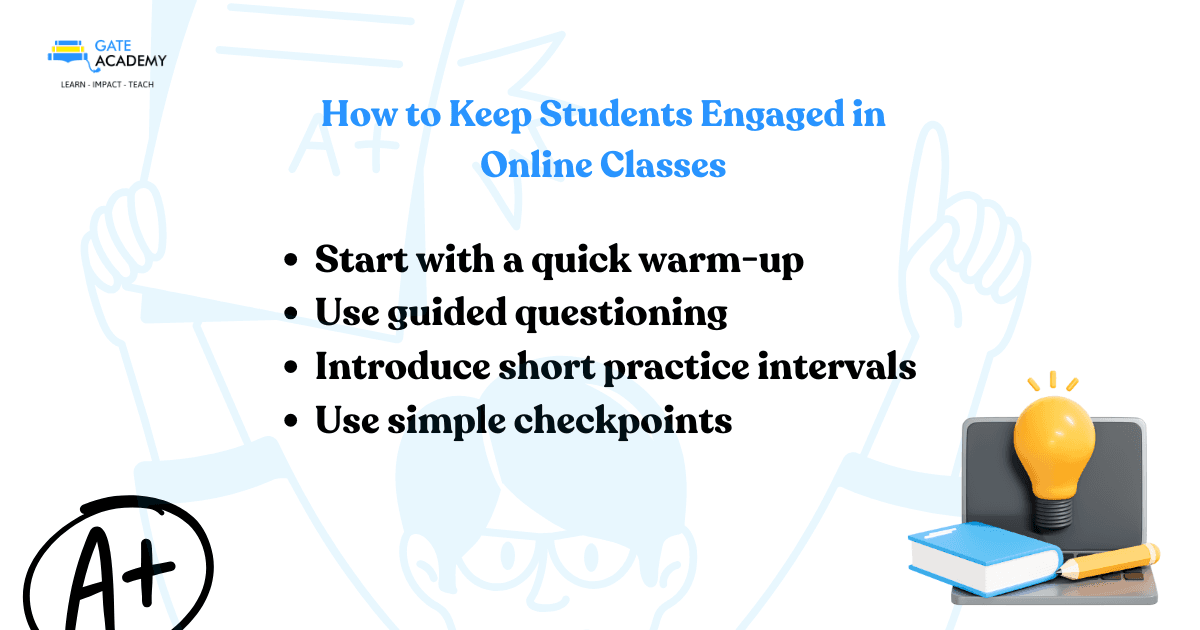
One of the biggest challenges in online teaching is not necessarily explaining concepts. It is keeping students mentally present and actively involved throughout the lesson.
Many tutors prepare thoroughly for class, understand their subject well, and still struggle with low student participation or fading attention midway into a session. This happens because engagement is not automatic in an online classroom. It has to be created intentionally.
At GATE Academy, we see a clear pattern. Students who are actively engaged during lessons tend to improve faster, retain concepts longer, and build stronger confidence over time. This becomes even more important when teaching difficult areas like high failure topics, where students already feel uncertain.
Online learning comes with built-in challenges. Unlike a physical classroom, students are often surrounded by distractions and have shorter attention spans. Without structure, it is easy for them to drift.
Engagement typically drops when:
When this happens, learning becomes passive, and passive learning rarely leads to strong results.
Engagement is not about making lessons entertaining. It is about making students active participants in the learning process.
In a well-engaged class, the student is not just listening. They are:
This continuous involvement keeps their attention anchored and improves understanding naturally.
Improving engagement does not require a complete overhaul of your teaching style. Small adjustments can make a significant difference.
Start by changing how your lessons flow. Instead of long explanations, break teaching into shorter segments and involve the student at each stage. A quick review at the beginning of the lesson can also set the tone, helping the student shift into learning mode early.
Guided questioning is another powerful approach. Rather than giving answers directly, lead the student step by step. This keeps them thinking and reveals whether they truly understand the concept.
It also helps to create small checkpoints during the lesson. Pausing briefly to ask a student to explain a concept back to you often provides more insight than simply asking if they understand.
Even experienced tutors can unintentionally lower engagement through small habits.
For example, talking for too long without interaction, solving questions without involving the student, or moving too quickly through topics can all cause students to disengage.
Another common issue is assuming silence means understanding. In many cases, a quiet student may actually be confused or disconnected. Recognizing this early and bringing them back into the lesson is a key teaching skill.
Engagement is not just about keeping students attentive. It directly impacts how well they perform academically.
Students who are consistently engaged tend to:
This becomes particularly important during exam preparation, especially when working through past paper strategies where focus and consistency are critical.
Strong tutors do not rely on chance to keep students engaged. They build it into every lesson through structure, pacing, and interaction.
At GATE Academy, we support tutors with practical tools to make this easier.
By making small, intentional adjustments to how you involve students during lessons, you can transform your classes from passive sessions into active learning experiences that lead to real academic improvement.